
„Gregor the beetle never found out that he had wings under the hard covering of his back. This is a very nice observation on my part to be treasured all your lives. Some Gregors, some Joes and Janes, do not know that they have wings.”
Vladimir Nabokov, Lectures on Literature, 1980
Few texts have shaped the literary education of German schoolchildren more than Franz Kafka’s The Metamorphosis. It is a canonical part of German school life: sitting in a stuffy classroom and reflecting on personal alienation. On whether having a crush on an older boy might already be an early sign of kafkaesque daddy issues. On using the word kafkaesque at all. The teenage brain thinks in themes and patterns, focusing on the personal and family relationships found in Kafka’s story. If you are lucky, though, this text stays with you into adulthood – and then a more precise adult brain may begin to dissect sentences into words and words into their particles and letters. It is perhaps no accident that, in German, we refer to the humanities as a science – Geistes-wissenschaft.
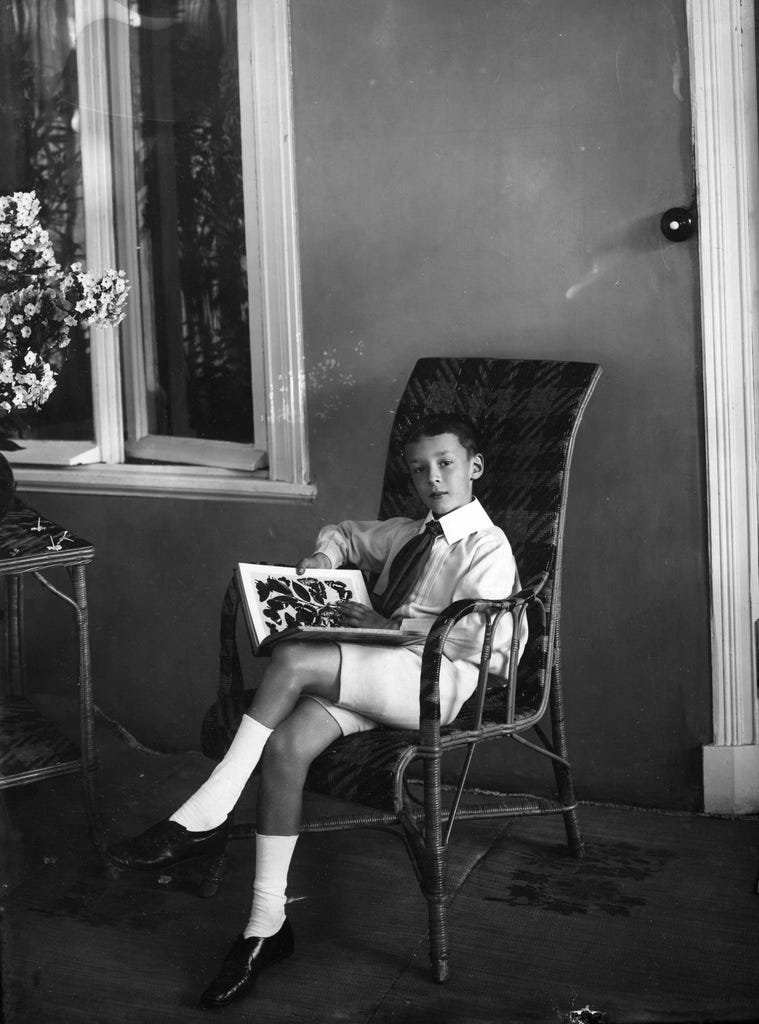
The young Vladimir Nabokov with a butterfly book, 1907. Photo: Karl Bulla, via Cornell University Library, Nabokov's Net exhibition. Public domain.
I.
“As Gregor Samsa awoke one morning from uneasy dreams, he found himself transformed in his bed into a monstrous vermin.” This is how Stanley Corngold, Kafka’s most widely read English translator, renders the opening of The Metamorphosis. The German reads: Als Gregor Samsa eines Morgens aus unruhigen Träumen erwachte, fand er sich in seinem Bett zu einem ungeheueren Ungeziefer verwandelt. Three German words carry all the weight: un-ruhig, un-geheuer, Un-geziefer. The same prefix, three different operations.
Un-ruhig (uneasy, restless): a clean negation of Ruhe (rest, calm). We know the thing negated, even though the negation turns our attention inward – an uneasy, restless state of mind. Gregor slept badly, we are told, awaking from the opposite of a peaceful sleep. Though, one might wonder, whether peaceful dreams have ever been considered worthy of literary treatment.
Ungeheuer (monstrous, enormous): here it gets more complicated.The word geheuer (homely, familiar, safe) is barely used in modern German; it survives almost exclusively in its negation. The un- has so thoroughly displaced the positive form that the word being negated has itself become a blank. The prefix has swallowed its opposite. The Etymologisches Wörterbuch des Deutschen defines the related Middle High German gehiure as “having nothing uncanny about it”. It defines itself by what it isn’t, and what it isn’t by what it is.
Ungeziefer is perhaps the most radical of the three negations. The word comes from Middle High German: ungezibere, the animal unfit for sacrifice. Geziefer originally referred to the domestic animal fit for sacrifice, the creature with a place in the sacred economy. Ungeziefer, then, is the animal that cannot be sacrificed, that falls outside the symbolic order. Not a domestic animal (un-geheuer, in fact!), not a wild animal. “Vermin” is too weak a translation: it captures only the practical nuisance. What Kafka writes means something stronger: the constitutively excluded.
In this one sentence, in these three un- words, the story announces its major theme. No longer an animal, Gregor has fallen out of the sacred order of society, and the first sentence wrests itself to make that linguistically tangible. He has become the un-animal. Franz Kafka himself imposed an aniconism on the story: When The Metamorphosis was to be published in 1915, he feared the illustrator would want to draw the insect: “Not that, please not that!”, Kafka wrote from Prague to his publisher Kurt Wolff. The prohibition is, in its own way, another un-: a refusal of what he must not become.
II.
One who defied this command was Vladimir Nabokov. Nabokov had left his Russian homeland and become an American citizen in 1945; he was an anti-Freudian by conviction and a lepidopterist by vocation. In the 1950s he taught literature at Cornell and delivered a series of now-famous lectures on classics of literary history. The psychoanalyst’s symbolism was of no interest for him. His method, not unlike the Russian Formalists, consisted in ostranenie – defamiliarization, the estrangement of the familiar. Its aim, according to Viktor Shklovsky, is to de-automatize everyday perception. But how does one defamiliarize what is already defamiliarized, already un-heimlich?
Nabokov outright rejected emotional identification with literary characters, whether for nostalgia or mere entertainment. The reader, he argued, should first trace the architecture of the work and its artful details, and in a second step decode them. Nabokov’s ideal reader unites the artistic and the scientific mind, and approaches metaphor and allegory through a laborious act of dissection.
Nabokov thus dissects the Ungeziefer with precision. Number of legs: at least six, probably six, therefore an insect. Shape: convex on both sides, belly and back. Color: brown. Mandibles: present and strong (Gregor uses them to turn the key). Body length: approximately three feet. All of this yields, Nabokov argues, not a cockroach (cockroaches are flat, Gregor is convex) but a beetle. A large, brown, dog-sized beetle. The housekeeper calls him a Mistkäfer, a dung-beetle. Nabokov corrects her gently: entomologically speaking, that is not quite right.
Up to this point the reading is almost amusing: a writer of world stature discussing Kafka’s Metamorphosis by the rules of entomology. Is the question whether Gregor has six legs or more of any real significance? It would not be, if Nabokov’s purpose were merely an identification of species. But he establishes something further: beetles of the type he has identified carry folded wings beneath their elytra, their wing covers. Small, fragile wings that can unfold and carry the beetle over long distances. “Gregor the beetle never found out that he had wings.” He never even tried to fly. “Some Gregors, some Joes and Janes, do not know that they have wings.”
Nabokov’s observation is indeed not symbolic: Gregor, the animal without category, carries a hidden capacity he never discovers. This follows from Nabokov’s consistent reading of the Metamorphosis itself. He can see the wings only because he has classified. He knows what beetles carry beneath their wing covers. The lepidopterist’s method produces a genuine finding. Therefore, the wings are real.
Nabokov’s Gregor is an animal: three feet, brown, convex, with mandibles and hidden wings. Kafka’s Gregor is Ungeziefer: the un-animal that cannot be sacrificed, defined precisely by its belonging to no category. Nabokov’s classification system turns the un-animal into an animal. It rescues something genuine while perhaps risking to sacrifice exactly what the title protects. This is, ultimately, the structural consequence of a method. And yet one must ask: does classification necessarily dissolve all ambiguity?
A language model asked what Gregor Samsa transforms into will answer: cockroach, or beetle, or insect. It cannot answer: Ungeziefer, at least not in the sense in which that word exists in German. It can produce the word and perhaps explain it, but the semantic structure of the un- prefix (negation without positive determination, exclusion without inclusion elsewhere) cannot be translated into a probability distribution. This is not a technical limitation that more training data could fix. It is the logic of the system. Nabokov applies a related logic and still finds the wings. The difference lies not in method alone, but in reading: in the time it takes, in the attention it owes the text.
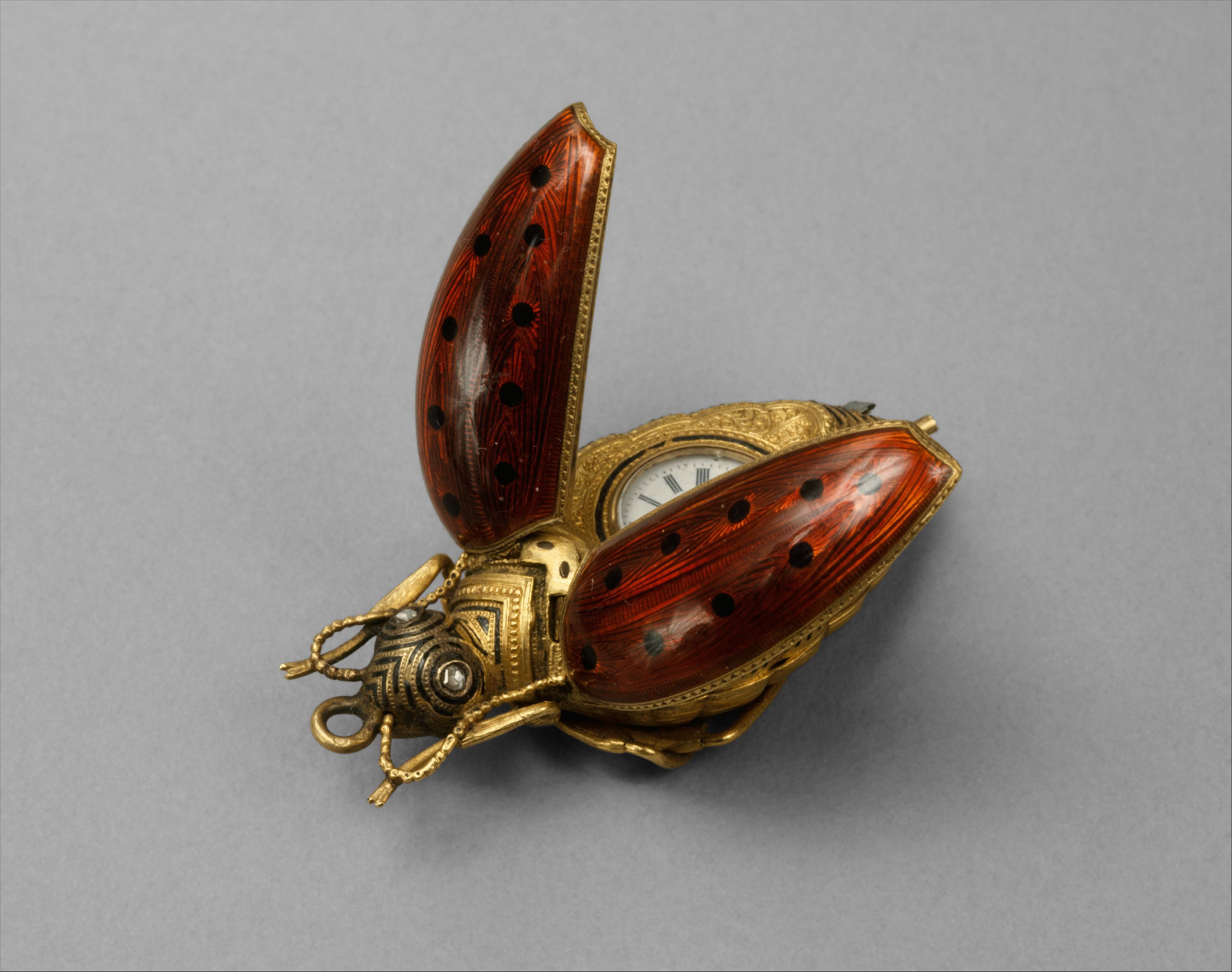
Beetle-shaped pocket watch, Switzerland, ca. 1850–60 (17.101.55). The Metropolitan Museum of Art, public domain.
III.
Gregor Samsa dies in his room, without ever having flown. Kafka knows this. Nabokov knows it too, and still offers his concluding sentence about the wings, as though it were a consolation: “Some Gregors, some Joes and Janes, do not know that they have wings.” This is the moment when Nabokov leaves the lepidopterist’s terminology behind and speaks as a writer himself. The method led him to the wings; the wings led him out of the method.
The un-animal has wings. The un-animal does not know it. And it remains what it is: the animal that cannot be sacrificed, even when taxonomy gives it a name.